Cascade control separates a slow master process from a fast secondary process, with the control valve acting as the final element of the inner loop. In this role the positioner must convert the secondary controller output into valve travel accurately and stably, without adding excessive dynamics of its own to the inner loop. Based on general control theory and official positioner manuals, this article covers role allocation, configuration, tuning sequence and verification; specific parameters are subject to the official catalogue and nameplate.
I. Role in a Cascade Loop
| Item | Content |
|---|
| Control structure | Master loop (slow variable) + secondary loop (fast variable); secondary setpoint comes from master controller output |
| Valve role | Final element of the inner loop, accepting the secondary controller output |
| Positioner function | Compares control signal with stem travel and issues a signal pressure to the actuator (per SAMSON official manual principle) |
| Common signal | 4-20 mA two-wire; HART / PROFIBUS PA / FOUNDATION Fieldbus depending on version |
| Key dynamics | Inner loop must be significantly faster than the master loop; positioner deadband and stroking time directly affect the inner loop |
| Main references | IEC 60534 (control valves), ISA-5.1 (instrument identification); positioner parameters subject to the official catalogue |
The essence of cascade is to reject disturbances inside the inner loop; the valve and positioner belong to the inner loop, not the master loop.
Sources: SAMSON official data sheets T 8384-3/4/5 EN and 3731-3 English catalogue (positioner principle); control structure per IEC 60534 and ISA-5.1.
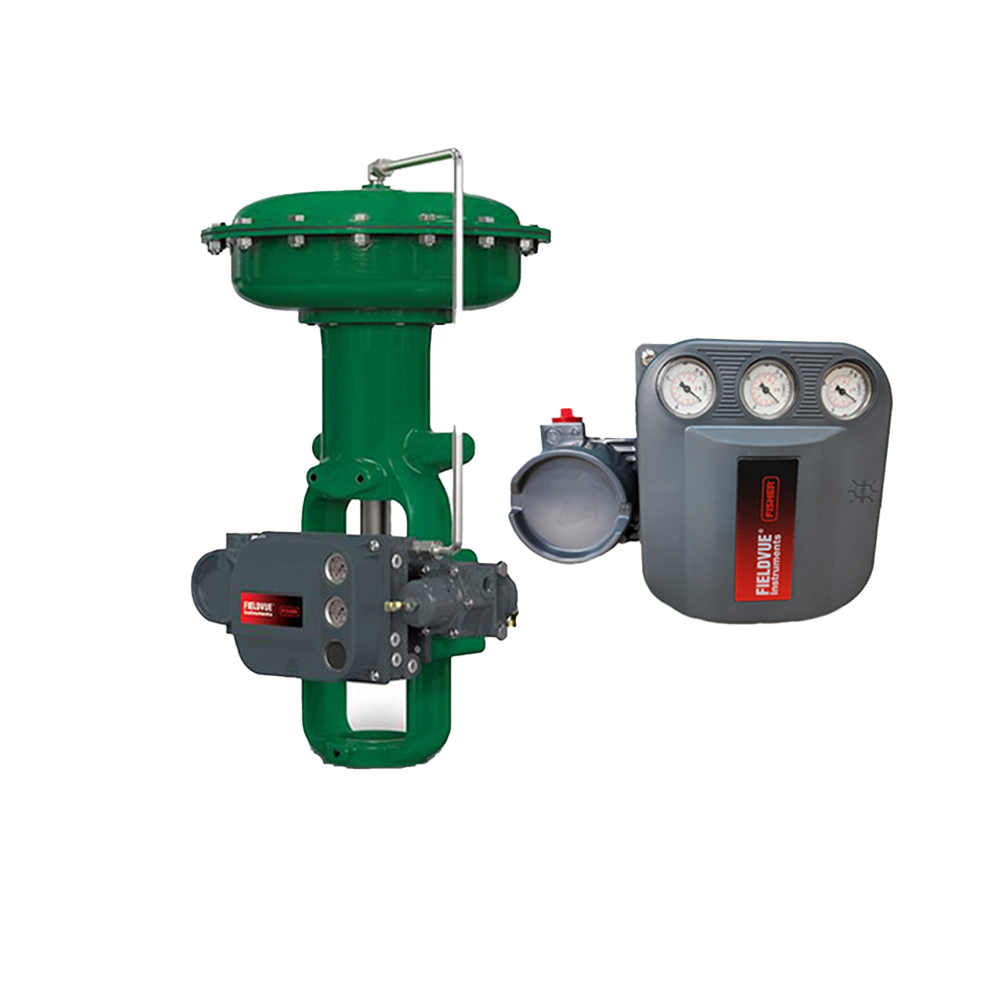
Digital positioner illustration, not the actual model; parameters subject to the official catalogue
II. Layered Responsibilities and Timing
| Layer | Typical variable | Timing order | Valve and positioner duty |
|---|
| Master loop | Slow variables such as temperature, composition, level | Minutes | Master controller output serves as inner-loop setpoint |
| Secondary loop | Fast variables such as flow and pressure | Seconds | Valve is the final element; positioner ensures travel tracking |
| Positioner inner loop | Stem travel x versus setpoint w | Milliseconds to hundreds of milliseconds | Compares w and x, outputs signal pressure y by PD law |
| Actuator | Air pressure signal and volume | Actuator dependent | Fills or vents air to move the stem to position |
Basis: SAMSON 3730/3731 official catalogues (positioner compares setpoint w with travel/angle x and outputs signal pressure y); layering per general cascade control theory.
III. Positioner Configuration Points
| Item | Requirement | Basis |
|---|
| Action direction | Set w/x reversibility per air-to-open/air-to-close and fail-safe position | Official manual |
| Input signal | 4-20 mA split range (e.g. 4-12 / 12-20 mA) set to the secondary controller output span | Official catalogue |
| Characteristic | Linear, equal percentage, quick opening or custom, matched to valve inherent characteristic and secondary variable | IEC 60534-2-1 |
| Deadband and hysteresis | Keep small while maintaining stability; excessive values degrade the inner loop | Official catalogue |
| Stroking time | Match the inner-loop rhythm; too fast may excite actuator oscillation | Official catalogue |
| Fail-safe | Valve position on loss of power/air must match the process safe state | IEC 61511 |
Parameters per SAMSON official data sheets T 8384-3/4/5 EN and Emerson/Fisher bulletin D104363X0CN (characteristics and split range); characteristic classes per IEC 60534-2-1.
IV. Tuning Sequence and Verification
| Step | Action | Check item |
|---|
| 1 Mechanical mounting | Set feedback lever and pin to rated travel | Full stroke free of sticking and looseness |
| 2 Initialization | Run auto-tuning to learn closed-to-open travel | Closed-loop operation with no alarm |
| 3 Characteristic and split range | Set characteristic curve and signal span | Command versus position point-by-point correspondence |
| 4 Deadband and gain | Increase gradually from small values | No sustained oscillation in the inner loop |
| 5 Inner before master | Tune the master loop only after the inner loop is closed | Master variable stable, no cyclic oscillation |
Tuning flow per SAMSON 3725 installation instructions (initialization P15, full-stroke movement, closed-loop operation); inner-before-master per general tuning practice.
V. Common Issues and Troubleshooting
| Symptom | Possible cause | Action |
|---|
| Slow inner-loop response | Insufficient positioner gain or excessive deadband | Repeat auto-tuning or raise gain per official manual |
| Cyclic valve oscillation | Gain too high or excessive air volume | Reduce gain or add volume restriction |
| Master loop overshoot | Inner loop not closed or too slow | First confirm inner loop is closed and speed it up |
| Position versus command deviation | Wrong split range or characteristic setting | Check official manual parameters and signal span |
| Bus communication loss on fieldbus version | Improper segment or device address configuration | Diagnose with official tools and manual |
Troubleshooting basis: Flowserve official document FCD LGENIM0105-16 (slow-response remedies); specific parameters subject to the official manual.
VI. Selection Guide and Common Models
Selection guide: First select the positioner communication version by the inner-loop signal form (4-20 mA/HART, PROFIBUS PA or FF), then check actuator action and fail-safe direction, then choose the characteristic curve to match the valve inherent characteristic and secondary variable, and finally complete initialization and inner-before-master tuning at commissioning. The positioner must not be tuned as part of the master loop.
Common models: SAMSON 3730-3 (HART), 3730-4 (PROFIBUS PA), 3730-5 (FF); Fisher DVC6200 (HART) and DVC6200P (PA) / DVC6200F (FF) variants; Masoneilan SVI series. Ordering codes are subject to the official selection tool.
If you are selecting a positioner for a cascade loop, please send us the secondary variable, signal form and actuator details. We can review the configuration and tuning sequence together.
Orders & Inquiries
Baoman Industrial Technology (Chengdu) Co., Ltd
Tel: +86 028-60220547 | Email: info@bit-cd.com
Address: Room 1108, Building A, Tingbiao Central Plaza, No. 158 Erxianqiao East Road, Chenghua District, Chengdu, Sichuan Province, China
The information above is not guaranteed to remain valid at all times. Subsequent changes will not be notified separately. Please confirm the latest information at the time of inquiry.
 简体中文
 ENGLISH


